The Longest Investment: Romain Taupenot on Control, Nature, and Ten Generations of Burgundy
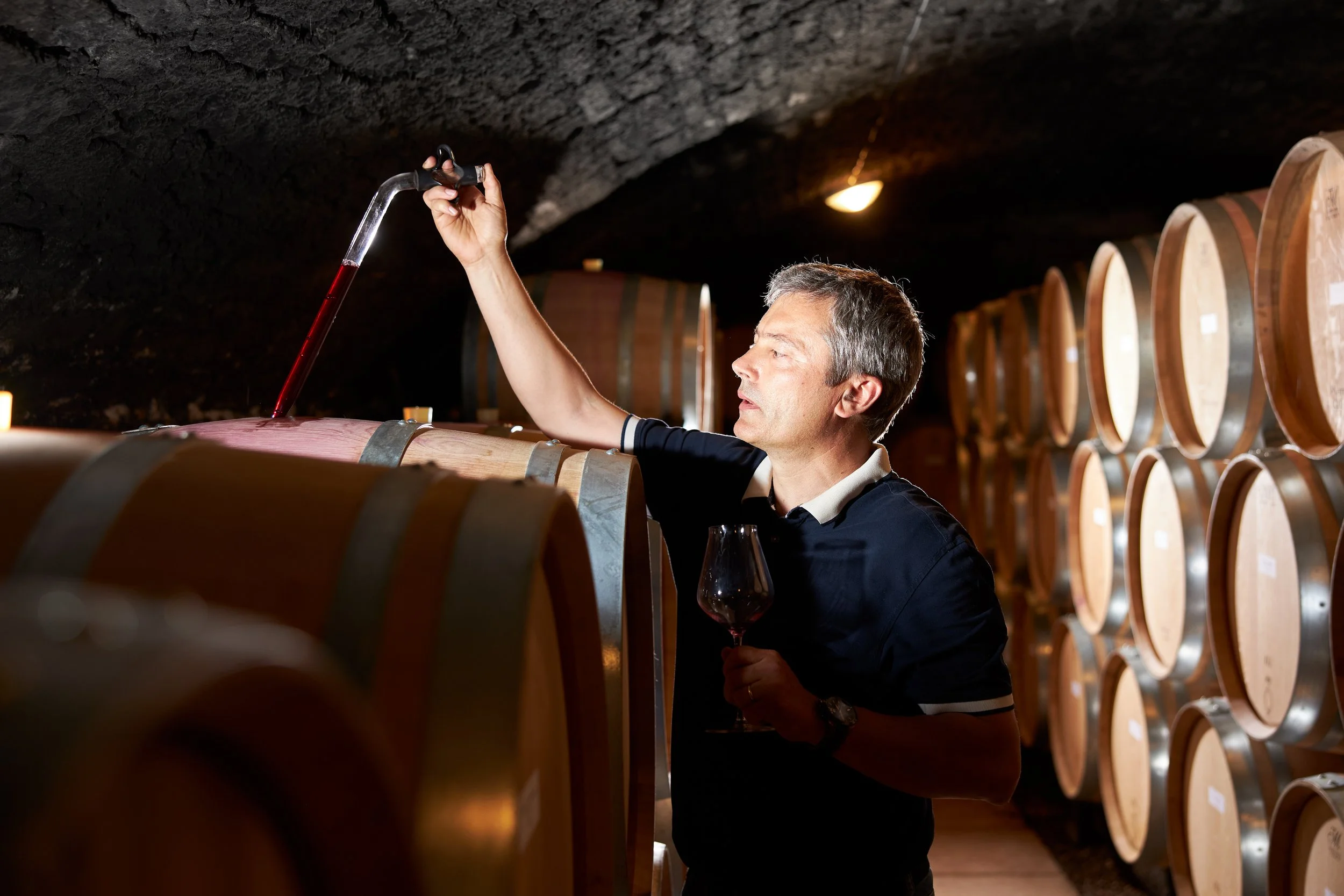
Romain Taupenot in his cellar. Image: Domaine Taupenot-Merme
I will admit it upfront: I am a devoted fan of Taupenot-Merme wines. So when I found myself sitting across from Romain Taupenot a grey morning in Copenhagen, I had to remind myself to ask questions rather than simply nod along. It turned out not to be a problem. Within the first ten minutes it became clear that Romain does not give short answers. Not because he is evasive, but because the subject does not allow for it. Burgundy, for him, is not a product. It is a living thing, and he treats it accordingly.
Romain is the co-owner and winemaker of Domaine Taupenot-Merme, a family estate based in Morey-Saint-Denis in the Côte de Nuits. His son Antoine was present too — quietly nodding at his father's descriptions, occasionally adding a word or two — and the ease between them made the conversation feel less like a formal interview and more like being let in on something private. Thank you to our Gold Sponsor Winegroup/ HJ Hansen /Theis Vine for setting up the interview.
At the end of the interview, Romain apologised for going in all directions. I told him not to. Every perspective had a strong point, and this was exactly what I had come for.
Seven Generations, One Address
The domaine's roots go back at least seven generations on Romain's mother's side, and nine on his father's. Antoine, who was sitting beside him, represents the tenth. It is a lineage that is rare even by Burgundian standards, and Romain mentions it with the matter-of-factness of someone for whom this is simply the background.
"I never missed a harvest. Except once, when I was in Turkey for my military service — I couldn’t get back in time. But apart from that, never. Since I was a child, I worked in the vineyards in summer. The winery was always part of life."
The estate farms around twenty hectares across nineteen appellations, spanning both the Côte de Nuits and the Côte de Beaune. The list of appellations alone reads like a sommelier's education: Gevrey-Chambertin, Morey-Saint-Denis, Chambolle-Musigny, seven premier crus, and four grand crus — including a tiny plot of Clos des Lambrays. The home base is Morey-Saint-Denis, a village that, as Romain would explain later in the conversation, is often undersold but never, in his view, misunderstood.
But before we got to the wines, I wanted to understand the man behind.
The Finance Director Who Never Missed a Harvest
Before joining the domaine, Romain spent roughly ten years in the corporate world. He began his career while completing his military service at a major pharmaceutical company in Istanbul, where he oversaw the subsidiary’s finance function, before moving on to roles as Head of Finance and Treasury at the group’s headquarters in Lyon, and later at another listed company based in Rennes. It is an unusual background for a Burgundian vigneron, and I asked how he had held it together with the life he had come from.
His answer was immediate:
“I never missed a harvest. Except once, when I was in Turkey for my military service — I couldn't get back in time. But apart from that, never. Since I was a child, I worked in the vineyards in summer. The winery was always part of life.”
The Commonality between Finance and Viticulture
You can't take the winery out of the man, even when you take the man out of it.
The corporate years, he insists, were not a detour but a preparation. He brought back what he calls painstaking attention to detail — precision, analytical thinking, the discipline of anticipation. Long-term planning, he notes, is something finance and viticulture share more than people assume.
“When you plant a new vineyard, you are not working for your own generation. You are working for the next one. You have to think years ahead.”
Antoine, beside him, nodded.
What the corporate world could not prepare him for, he admitted, was the fundamental loss of control that comes with farming. In finance, he said, you can always build a model to correct a bad prediction. In the vineyard, you cannot negotiate with the weather.
“If you have real frost, or a year like 2024 — we had 1,500 millilitres of rain between October 2023 and October 2024, and we lost about 80% of our crop. We didn't even produce any Mazoyères-Chambertin that year. No model helps you there.”
Coming Home, Finding a Voice
Joining a family estate that has existed for ten generations is not straightforward, even when you are family. Romain was frank about this.
“Working in a family is very challenging. Especially because I came from organisations that were fully structured. When I joined the estate, I had to argue about how to organise things, how to develop. You need to share the same vision. In a company, there are limits you cannot cross. In a family, those limits are blurrier. That is both the beauty of it and the difficulty.”
His father — still alive and, as Romain notes with a smile, still visiting the estate regularly, perhaps due to a lifetime of drinking Burgundy every day — was anxious when Romain decided to convert to organic farming. The older generation had built the estate one way; here was the son arriving with different ideas.
"We have to make wine in a balanced way, with fruit transparency and definition — the great markers of terroir. And the wine has to be lively, with good energy. This is especially key now, with global warming."
The transition to organic viticulture began in 2001. The official certification finally came in 2024 — which Romain describes, with considerable understatement, as not the easiest year to get it. They lost most of their crop to mildew. Sixteen treatments were applied. It was not enough.
But the philosophy behind the decision has not wavered. Organic farming, for Romain, is not a marketing position. It is a precondition for making wine the way he believes wine should be made.
“The vine is just a vehicle. It transmits mineral elements from the soil to the grape. Unless you intervene with products, the more naturally you work, the more the wine speaks the truth of its place.”
No Makeup
Romain's winemaking philosophy can be summarised in two words he uses himself: no makeup. No external yeasts, no added bacteria for malolactic fermentation, no fining. Fermentation is spontaneous; everything follows at its own pace. The wines spend time in barrel, but new oak is kept firmly under control.
“I really enjoy vanilla — but in a dessert, not in my wine. If you use too high a proportion of new oak, you lose the authenticity of the wine. And once you start using commercial yeasts, you standardise. You are no longer making something unique.”
In practice, this means slowing down at every stage, accompanying the wine rather than directing it. He draws a distinction between intervening and accompanying — and it is one he returns to several times. The goal is not to be passive, but to be present in a specific way: attentive, precise, and restrained.
Balance, he says, is the ultimate measure. Not power. Not concentration. Balance.
“We have to make wine in a balanced way, with fruit transparency and definition — the great markers of terroir. And the wine has to be lively, with good energy. This is especially key now, with global warming.”
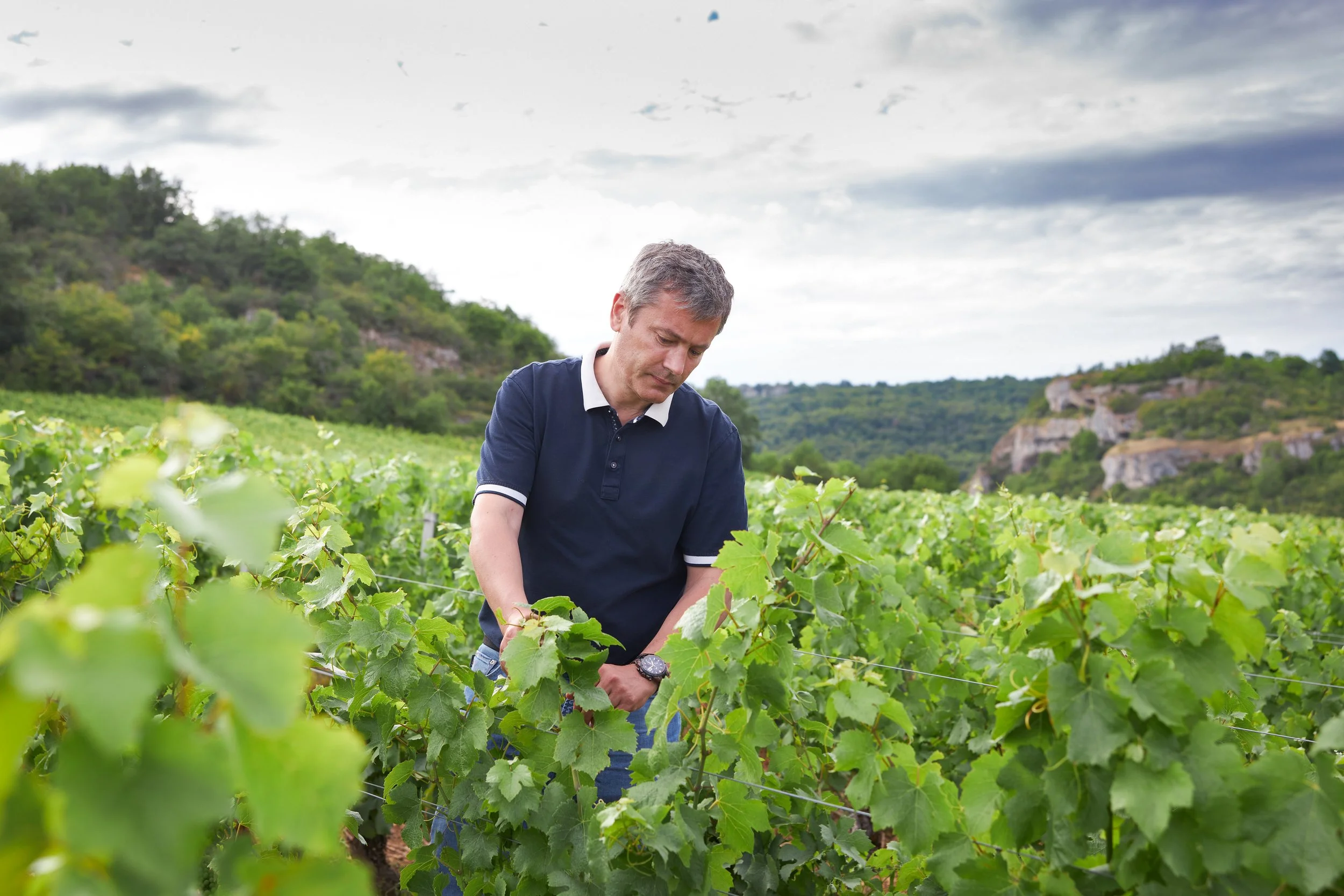
Romain Taupenot in the vineyard. Image: Domaine Taupenot-Merme
The Character of Morey-Saint-Denis
I asked Romain to describe Morey-Saint-Denis to a sommelier in thirty seconds. He laughed, and took considerably longer.
For years, he said, the village suffered from an identity problem — promoted as something between Gevrey-Chambertin and Chambolle-Musigny, rather than as itself. He no longer accepts that framing.
“The wines from Morey are completely their own. Darker fruit than Gevrey or Chambolle — sometimes black fruit — but above all, there is a floral character, a touch of violet, and a spiciness that you find across the appellation whatever the vintage. That is what I would say is the signature of Morey.”
He also notes something structural about the village that sets it apart: it is the only commune in the Côte de Nuits where, from north to south, you have an unbroken continuum of grand cru. No disruption, no gap. A rare coherence of terroir that does not exist elsewhere.
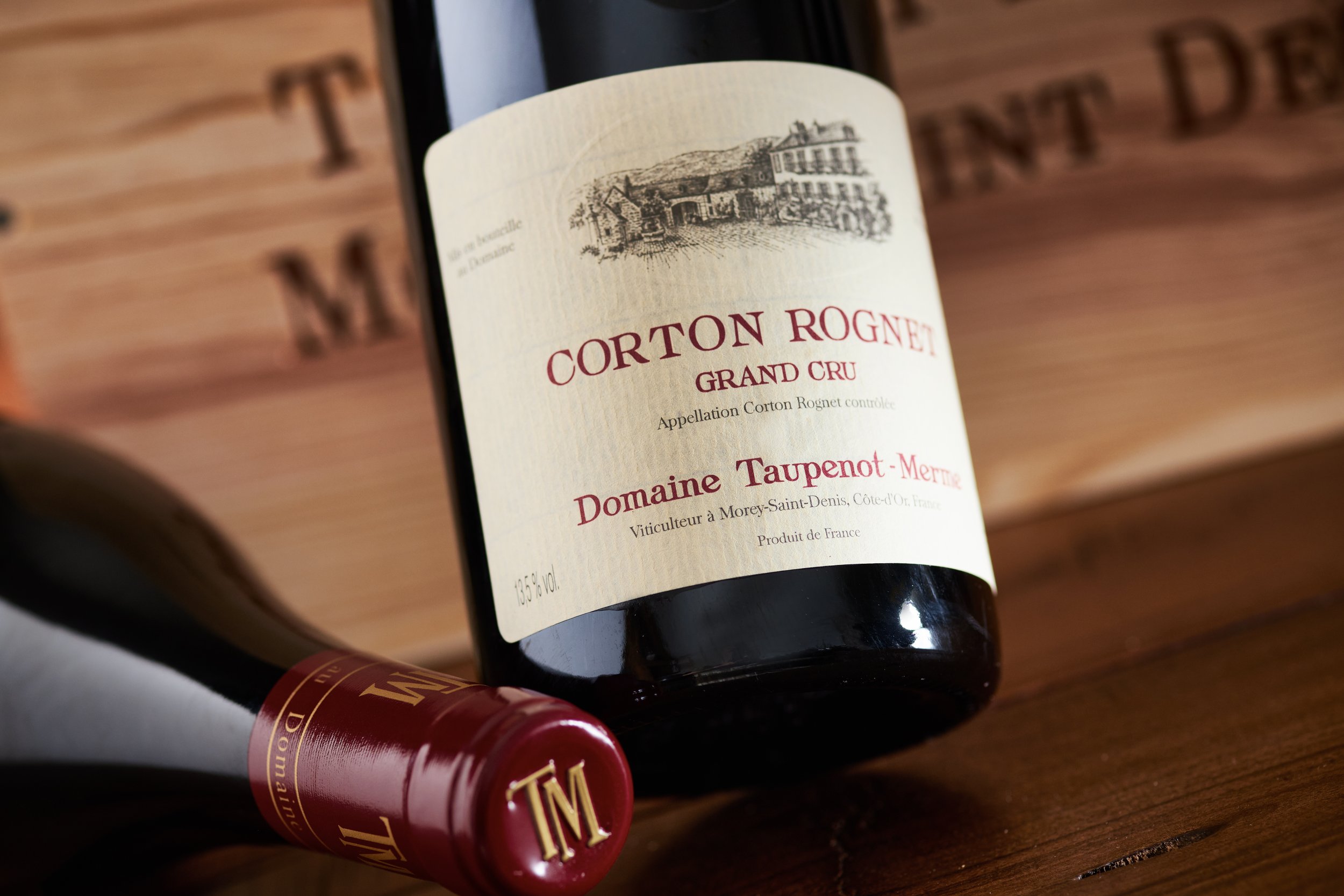
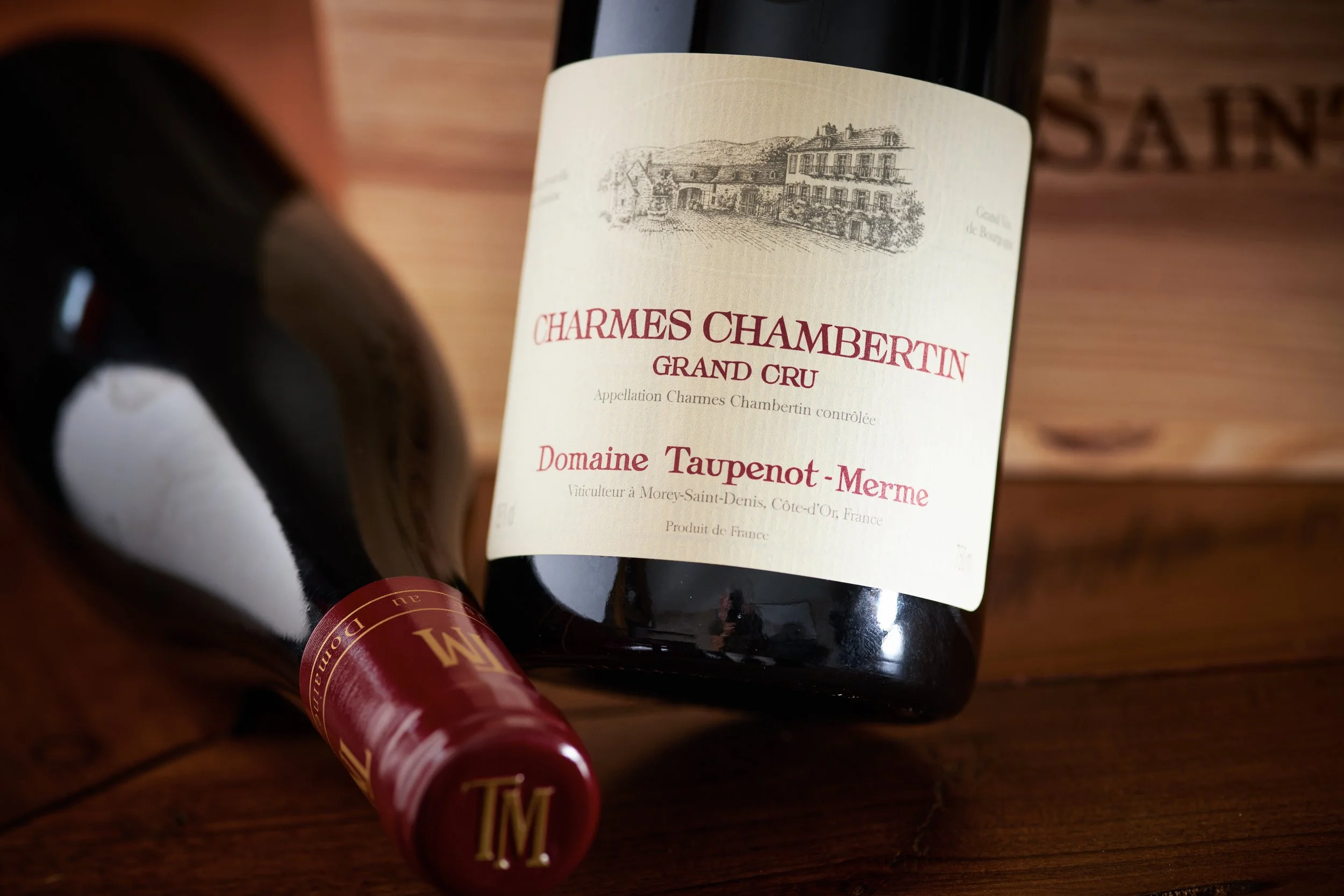
At the domaine, the Mazoyères-Chambertin grand cru is the most concentrated expression of this floral, spiced character — layered, precise, and marked by refined tannins that make the wines approachable even when young. I have had the pleasure of tasting several of the domaine's wines, and this quality — that sense of energy and purity, fruit so alive it almost hums — is what keeps me coming back.

Sponsored banner from Theis Vine
Reading the Berry
In the ten days before harvest, Romain works by hand and by mouth. Literally.
“I start picking fruit about ten days before the expected harvest date and sending it to the lab. But what matters most to me is not the analysis — it is the quality of the tannins. I crack the seeds and taste them. I look at the colour: if the seeds are fully brown, ripeness is there. If there is still green, it is not.”
Antoine added that in the context of today's warmer vintages, phenolic ripeness matters far more than alcoholic ripeness. Getting the sugars up is no longer the challenge. The question is whether the tannins are ready — whether the wine will have the structure and elegance to age.
"Patience. The wine will deliver over time. If you open a young bottle and pour it immediately, you are getting perhaps half of what it has to offer. Open it two or three hours in advance. Pour a small glass. Let it breathe. Come back to it. The evolution over the course of an evening can be extraordinary."
In difficult years like 2023, this meant ruthless sorting. Heat events in August shrivelled some berries; by harvest, those berries carried high alcohol and overripe, plummy character that would have pulled the wines away from the fresh, red-fruited profile the domaine is known for. Sorting them out cost volume, but protected the wines' identity.
“You have to produce little, but great.”
Patience, Above All
When I asked what he would most want people to know about Taupenot-Merme wines that we hadn't yet discussed, Romain did not hesitate.
“Patience. The wine will deliver over time. If you open a young bottle and pour it immediately, you are getting perhaps half of what it has to offer. Open it two or three hours in advance. Pour a small glass. Let it breathe. Come back to it. The evolution over the course of an evening can be extraordinary.”
He is not a fan of decanters for his reds — too much oxygen too fast, he says, which can flatten the very vibrancy that makes the wines interesting. The better method is time in the glass, slowly, with attention.
It is an advice that reflects everything he had said over the previous hour. The wine is alive. You accompany it. You do not rush it. You earn what it has to give. As someone who has long admired these wines, I left the conversation understanding — finally — exactly why they taste the way they do. Not by accident, and not by formula. By conviction, patience, and ten generations of knowing exactly where you are.