Quiet Precision in the Hemel-en-Aarde
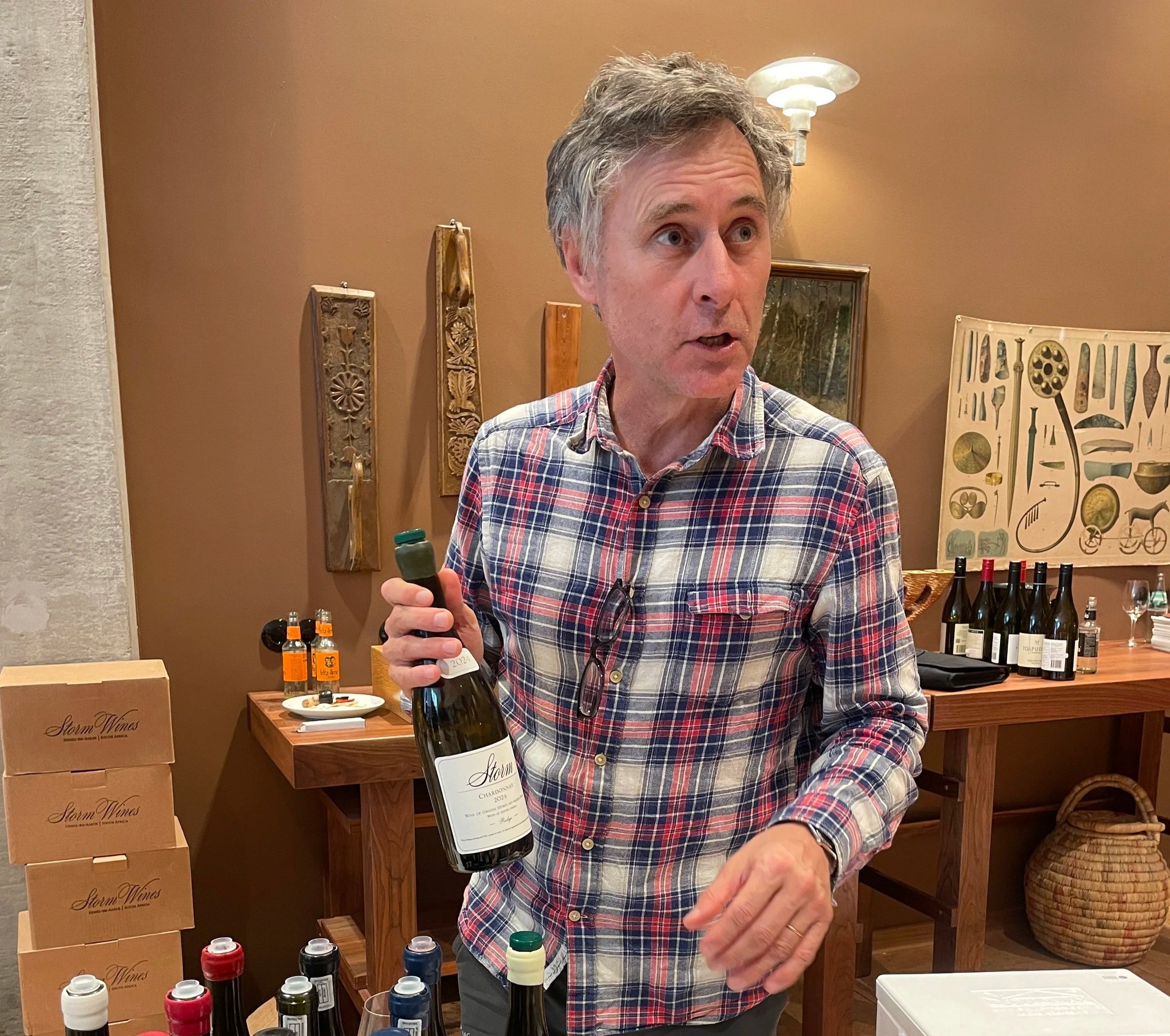
Hannes Storm. Image: Anne Køster
Don't let the name fool you. Hannes Storm’s motto ’stick to your knitting’ says it all about this calm, methodical, and utterly focused winemaker — and that is precisely why his Pinot Noirs and Chardonnays from the Hemel-en-Aarde are among the most thrilling wines South Africa has ever produced.
Hannes Storm laughs when the subject of his surname comes up. Storm Wines — the name works beautifully from a marketing perspective, he acknowledges. But it has nothing to do with his character. "I can be calm," he says, "but I can be in a mode of storm." He pauses. "No — I'm actually very calm." Slow, steady, continuing. That is exactly the feeling of meeting Hannes in Copenhagen.
The story of Storm Wines begins, as so many great South African wine stories do, in the Hemel-en-Aarde — the Valley of Heaven and Earth — where Hannes spent thirteen years as a winemaker before quietly launching his own label on the side in 2012. The first release came at the end of 2014. By then, he already knew exactly what he wanted to do, and exactly how he wanted to do it.
"From the beginning, the philosophy was to give the wine the chance to mature and show its true colours without intervening. As a winemaker, my task is basically just to steer the fruit to the bottle. The most important 1% of my influence is the time of picking — making sure the wines have ripeness, but at the same time freshness. Wines that are ready upon release, but also have the ability to mature and show secondary and tertiary characters while retaining that freshness.
Three Soils, One Philosophy
Storm Wines holds a unique position in South African wine: it is the only producer to make single-vineyard wines from all three appellations within the Hemel-en-Aarde — the Valley, the Upper H&A Valley, and the H&A Ridge. Three Pinot Noirs, two Chardonnays, all made with an identical approach in the cellar. The differences come entirely from the land.
"Without enough clay, you have beautiful perfume — but you lack structure and texture."
The Vrede vineyard sits closest to the ocean on warm, north-facing slopes of Bokkeveld shale-derived clay — iron-rich, heavy, and naturally low-yielding. Yields rarely exceed two tons per hectare. Moving 100 metres up in elevation, the Ignis vineyard sits on decomposed granite in the Upper Hemel-en-Aarde, with less clay, more quartz, and a more angular tannin structure, perfumed character in the wine. Another 100 metres higher still is the Ridge — back to Bokkeveld shale, but cooler, more exposed to the cool south-easterly winds, planted at 7,500 vines per hectare rather than 4,500, and catching only morning sunlight on the cooler slopes.
"For Pinot Noir, it is very important to have enough clay in the soils. Without it, you have beautiful perfume, but you lack structure and texture. On Ignis — even on granite — we have enough clay to bring texture and structure, although the wines are more perfumed and the tannins a bit more angular compared to Vrede, where we have a finer-grained tannin. Then Ridge is cooler, more mineral, darker fruit and length with spicy undertones. There is a golden thread between them, but they are definitely different."
"Without enough clay, you have beautiful perfume — but you lack structure and texture.”
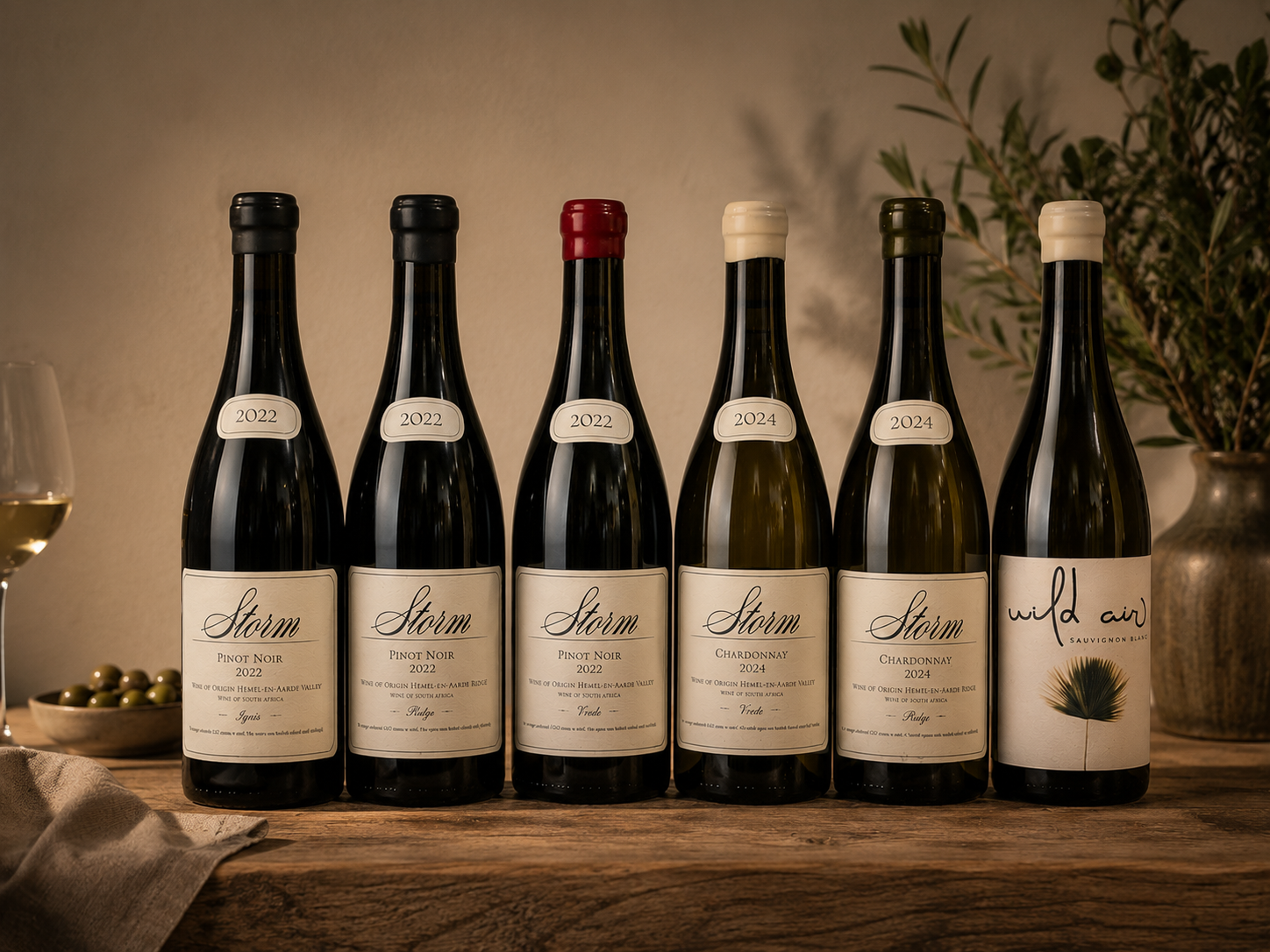
Storm wines. Image: Hannes Storm
Measure Everything. Then Let Go
Hannes Storm describes himself as having both a left brain and a right brain — but it is the left that tends to lead. He is perfectionistic, precise, and deeply scientifically minded. He speaks with quiet authority about soil profiles, plant density, clay content, and pH. And yet his winemaking philosophy, arrived at through years of careful observation, is fundamentally about restraint.
"I always like to know where we start off. If you know where you start, you know where to intervene — or not intervene. The wine makers and wine growers that are the most successful know what is going on: the soils, the plants, the vines, the wines. You can never throw the chemistry and the pH out of the window. All your decisions need to be based on actual, known, measured facts."
But once the data is gathered and the decisions are made, the philosophy shifts entirely.
"You set it all up, you measure everything — and then you let go. We cannot make wine with a recipe. From the first vintage, I already knew that very well. We have not changed anything from a winemaking perspective, apart from working even softer: leave the fruit alone, a cold-soaking period, fewer punch-downs. The great thing about that is we can compare apples with apples — 2012 versus today. And the vineyards are getting older, which brings extra positive notes to the wines, especially from a structural and textural point of view.
"The cool Atlantic is really becoming very important. It is our buffer — and it is 1.8 kilometres away."
Baboons, Biodiversity, and the Atlantic
The Hemel-en-Aarde is not only one of South Africa's finest wine regions — it is also a working ecosystem, farmed in the shadow of mountain ranges teeming with wildlife. Storm mentions the three Bs that keep him on his toes: birds, baboons, and botrytis. The baboons, he explains with evident affection, require a kind of diplomacy.
"We have a very good relationship with the baboons, but we keep them on their side of the fence. They don't only eat what they pick — they pick a hundred times more. They break the plants, damage them for the next few years' growth, and rip the bird nets off. So we draw an imaginary line in the mountain and keep them on the other side — just scaring them off. But it is also fantastic to have them around. It adds to the diversity. We are farming in a beautiful, pristine environment with mountains on both sides, a lot of fauna and flora. We try to preserve it for the next generation."
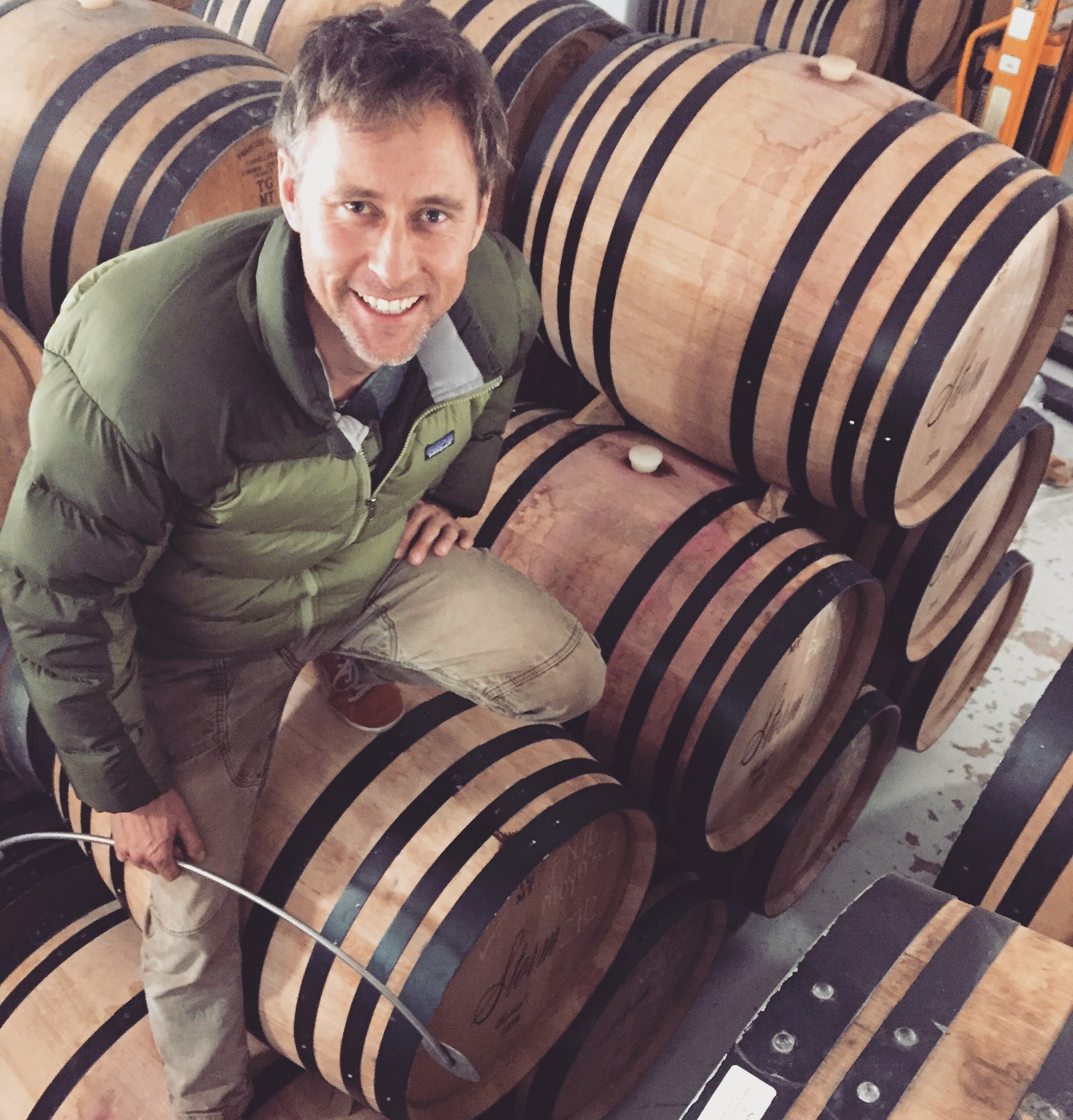
Hannes Storm. Image: Hannes Storm
That same pristine environment is also Storm's greatest ally against climate change. The Atlantic Ocean sits just 1.8 kilometres from his closest vineyard, and the cool Benguela Current — flowing up from Antarctica — acts as a natural buffer against rising temperatures during the critical ripening phase.
"The cool Atlantic is really becoming very important, especially in the latter growing phases. Pinot Noir is very susceptible to high temperatures, and for the preservation of those fine aromatics — that is really important. We are also getting more challenges from unpredictable weather. What it has taught me is just to be more proactive, to change direction fast, and make quick decisions. We cannot wait and ponder too long. We have to be agile."
"The cool Atlantic is really becoming very important. It is our buffer — and it is 1.8 kilometres away."
One Foot in Each World
Storm's Chardonnays are frequently compared to Burgundy — and sometimes to the best of Australia. He accepts the comparison with equanimity, though he is clear that emulation was never the goal.
"It is impossible to know a terroir well after five or ten years. It takes fifteen, twenty — and you still keep learning."
"We don't try to emulate other regions. I'm quite happy that the wines have a classical style — maybe one foot in the old world, one foot in the new world. And when they get age, they gravitate towards Old World style, because we have very good natural acidity. In blind tastings these days, the outcome and the guessing of where it's from is getting more and more interesting. It just happens to be more classically styled. I think that also has to do with not intervening — the choice of barrels, the time of picking, the alcohol levels, the balance between ripeness and length."
Stick to Your Knitting
Storm Wines is run by Hannes and his wife Nathalia, with a permanently employed cellar team of four. There is no ambition to grow. The question of scale, he says, answers itself once you know what you value.
"You have to ask yourself: where do you want to be, and what do you want to pursue, and how much time do you want for yourself and for your family? We believe we have some of the most fantastic terroirs to work with — small pockets in these three appellations — and we don't want to dilute it by just scaling. We love the fact that as a family, and with our small team, we can really be part of the whole process: from the soils and vineyards to the actual bottling and shipping of the wines. If we scale, we will not be able to do that."
He returns, as he often does, to a phrase that feels like a personal motto: stick to your knitting. He is on his 27th vintage in the Hemel-en-Aarde. He has come to understand that truly knowing a terroir takes decades, not years — and that the learning never stops.
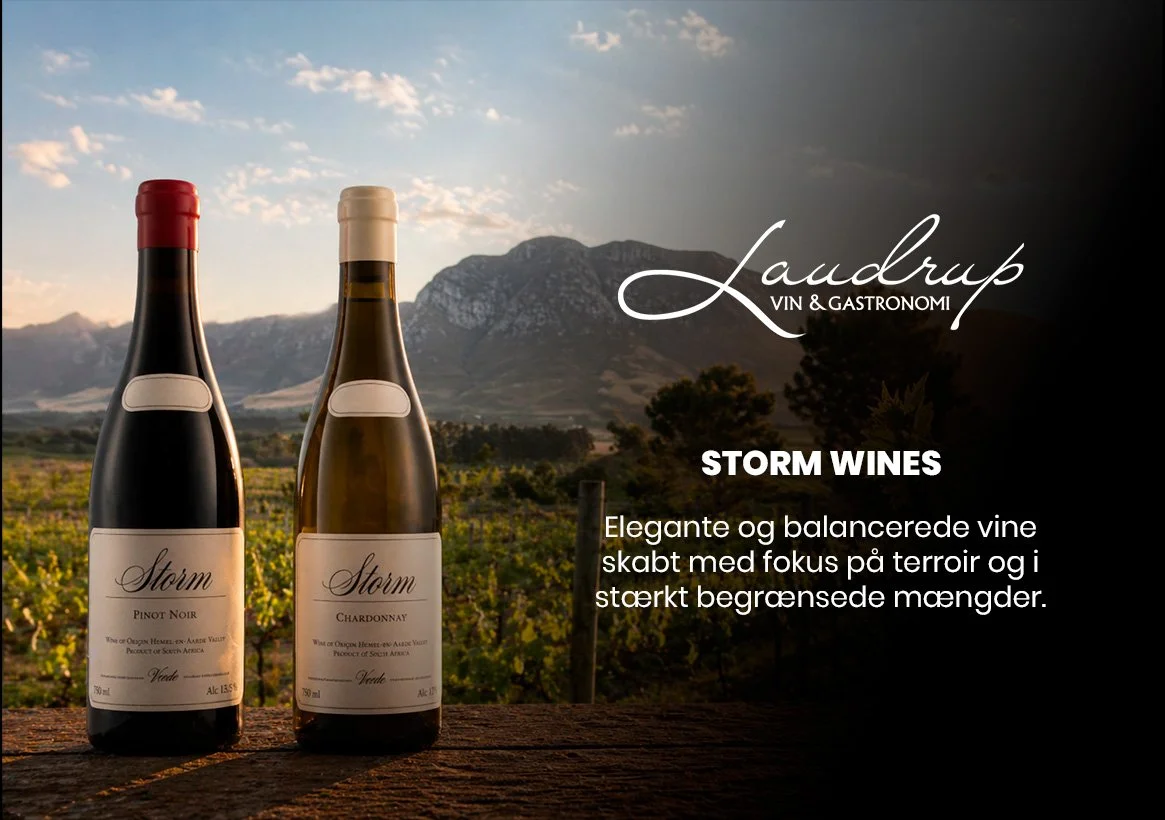
Sponsored banner from Laudrup Vin
"It is impossible to know vineyards and terroir very well after five or ten years. It takes fifteen, twenty years — and you still keep on learning as you go. I've just realised that."
"It is impossible to know a terroir well after five or ten years. It takes fifteen, twenty — and you still keep learning."
How to Serve the Storm Wines
When a sommelier stands with a bottle of Storm Wines, Hannes has one practical request before anything else: give it time. The wines are typically tight on opening and need an hour — at minimum — to reveal themselves.
"The wine that makes you think when you taste it in the glass — that, for me, is personality. A wine that evolves in the glass, with aspects that are not easy to define. I think that is a bit of mystique. Our wines are evolving quite a lot in the glass, and that makes them so much more interesting. You need to give them some time. Open the bottle an hour before you start drinking, and then you can jump on and see the journey of this wine evolving in a very positive way."
The name Storm may suggest drama, but the wines — and the man behind them — tell a quieter, more patient story: of precise observation, deliberate restraint, and a deep, unhurried respect for three small pockets of extraordinary South African earth.