Threading the Needle: Greg Lambrecht and the Story of Coravin

Greg Lambrecht, the founder of Coravin. Image: Coravin
It is late autumn when I walk into Nimb restaurant in Copenhagen together with Greg Lambrecht, the founder of Coravin, and his colleague Lambert Manden, who is Senior Regional Sales Manager. We are here for lunch, and the atmosphere is relaxed from the start. Greg is lively and curious, quick with a smile, and always ready to explain with small calculations. Lambert is attentive and engaged, and when he speaks about the professional side of Coravin, it is clear and precise. The interview was set up by our gold sponsor Torben Straarup at Wine-Group/H.J. Hansen Vin.
As we look at the menu, I try to teach them a Swedish word: löjrom. We repeat it together and laugh at the sound. It becomes a small game, and it sets a light and warm tone for the conversation.

Image: Coravin
From Boston to Burgundy
Greg tells me he was born in New York, grew up in California and lived in Boston since his studies and trained in medicine. He invented medical devices for much of his career. “When you invent medical devices, nobody cares about the inventor. People think about the surgeon they are interacting with. But with wine it is different. Wine is social, and Coravin is a consumer product. So I had to become public in a way I never had before,” he explains.
He grew up with needles around him. His father had diabetes and injected himself daily. “I was very good with needles from a young age,” he laughs. “I saw my dad draw insulin with a syringe every day. That image stayed with me. Later, when I started thinking about wine, the idea of using a needle came naturally.”
A side project that became a company
The story of Coravin starts in 1999. Greg’s wife was pregnant, and he wanted to enjoy wine without opening bottles. “I first tried sticking a needle through a cork and pulling wine with a syringe. But I created a vacuum, so the wine sucked back in. I realized I needed to add gas.”
Being a physicist as well as an inventor, he tested different gases. “I tried nitrogen, helium, other noble gases. In the end I chose argon, because it is inert and has no chemical reaction with wine. It is made by cooling air until it separates into gases. It is everywhere in the atmosphere.”

Sponsored content from H.J. Hansen Vin
Editor’s Note: What is Argon?
Argon is the gas used in all Coravin still wines systems. (In the Sparkling Coravin they use CO2 gas). Argon is one of the noble gases, which means it does not react chemically with wine. Argon makes up about one percent of the air around us and is produced by cooling air until the different gases separate. Because it is heavier than oxygen, it forms a natural blanket over the wine and keeps it safe from oxidation.
At the time, Greg was CEO of two medical companies. Coravin was a side project he did in his spare time. He tested about 800 wines before launching, six bottles of each. For years he built prototypes for friends. In 2011 he finally decided to commercialize.
“The first name was not Coravin,” he laughs. “My son called it Wine Mosquito, because the prototypes looked like a mosquito. We used that name until I hired a CEO, who said, ‘People hate mosquitoes. We cannot use that name.’ I had studied Latin. Cor means heart. For me, the heart of wine is variety and sharing. So Coravin became the name.”
Just as he finishes the story, the löjrom we joked about earlier arrives at the table. It feels like a fitting moment. The Nordic specialty is in front of us, and Greg (the man with the needle) is talking about the heart of wine and why Coravin is built on the idea of sharing.
The toughest part
The toughest challenge was the regulator. The gas capsule inside a Coravin holds 200 bar of pressure, but at the needle tip you need only 1.5 bar. “We had to invent the most accurate and least expensive high-pressure regulator in the world. It is better than what the oil industry uses. That almost bankrupted the company.”
The second challenge was testing. There are hundreds of thousands of wines every year, all with different corks, closures, bottles. “Before launch I tested 800 wines. Since then I have tested thousands more. When we moved into sparkling, we had to start all over again, because sparkling bottles and closures are all different.”
Greg still works as a surgeon. “I love solving problems. When someone says, ‘Can you fix this,’ I take it as a mission.”
Coravin Tasting
At Nimb we do a tasting together. Wines that had just been opened are compared to wines poured with Coravin a month ago. It is blind, and I try to guess. The three white wines I got right. On the reds I also guess two out of three correctly, but I admit it could be luck. None of them are oxidized or flawed. “My guiding star was the slight change in color I noticed in the wines that had been “Coravined” (yes, I know it’s not really a verb, but you get me) a month earlier.”
Greg nods. “That is why we blind test. Placebo effect is powerful. Sommeliers are skeptical, and they should be. So we test again and again. I want data, not just opinion.”
He tells me proudly: “Right now, 1.3 glasses are poured with Coravin every second worldwide. My goal is to reach two, then three. My vision is that every wine should be available by the glass.”

Sponsored content from Theis Vine
Denmark and early adoption
Greg has been to Denmark a few times, but Coravin was already here before him. “Danish sommeliers saw Coravin in New York and San Francisco. They bought it and brought it back. So Denmark adopted it early, before I even came here. Denmark is very forward-thinking,” he says.
He compares regions. “Burgundy said yes, Champagne said yes, Bordeaux said no. In Bordeaux people feared counterfeiting or that people would drink less. But the opposite happened. People drink better quality wines they can drink by the glass. They open better bottles on weekdays, because they know they can save the rest.”
He smiles. “Not every day is worth a hundred-dollar bottle, but every day is worth a twenty-dollar glass.”
Lambert says: “The Coravin Pro system is designed for restaurants. It connects to a larger argon source, so the cost per glass is lower. Sommeliers can serve very fine bottles by the glass without fear. It is a game-changer for the professional side.”
Greg nods in agreement. “I measure our success not in units sold, but in glasses poured. That is what matters.”
NoLow segment
Greg also sees potential in no- and low-alcohol beverages. “We have tested dealcoholized wines,” he says. I want Coravin to be agnostic: wine, no wine, high alcohol, low alcohol, sparkling, still. That is the dream.”
He adds that after our meeting he will test Copenhagen Sparkling Tea, which they had put under Coravin about a month earlier. “I am very curious to see how it has held up,” he tells me with a smile.
(Editor’s note: Lambert wrote to me a week after we met in Copenhagen to say that the sparkling tea served “coravined” had been a success. Both Greg and he admitted they struggled to tell which sparkling teas had been coravined and which had not.)
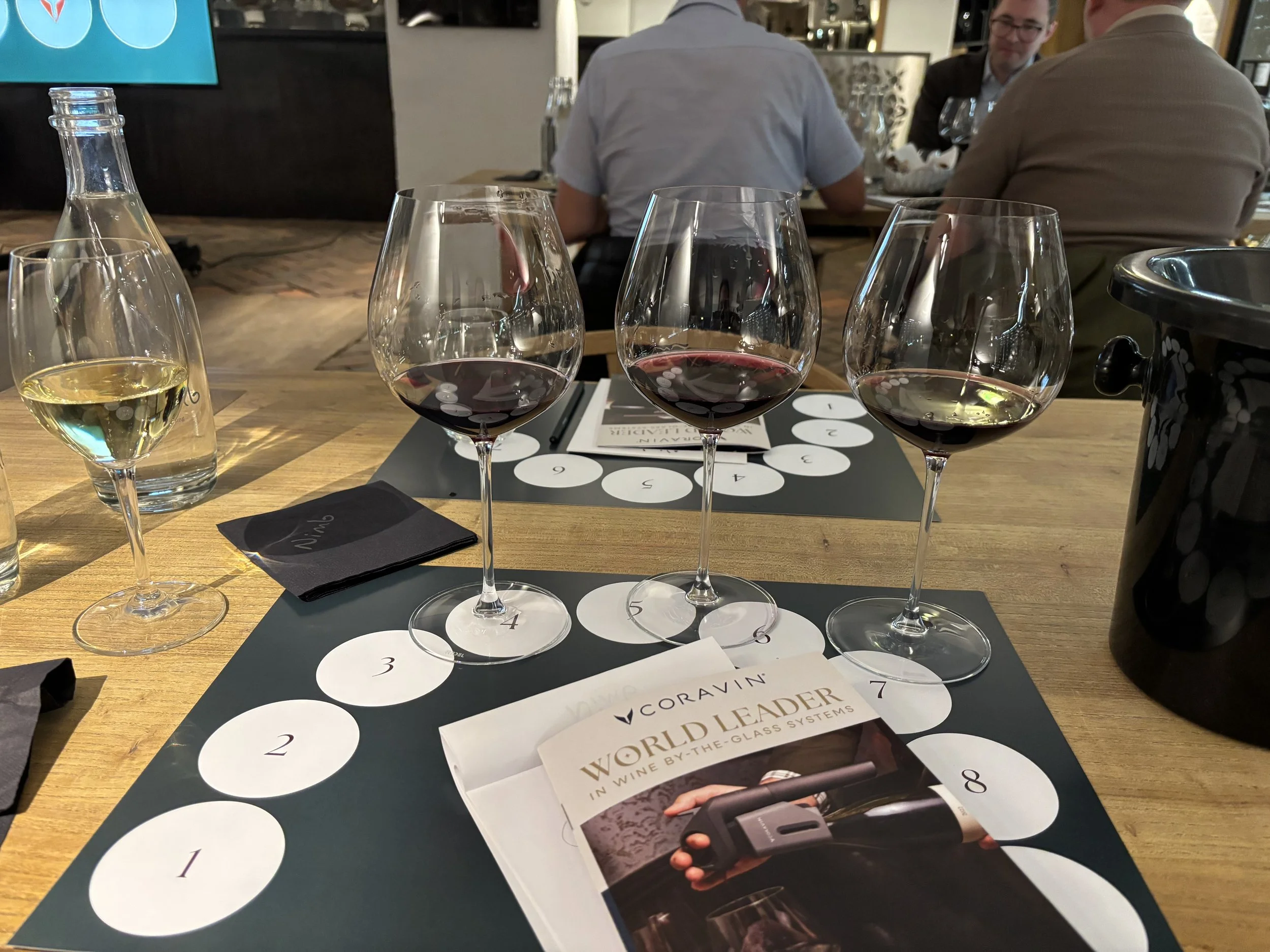
Nimb + Coravin. Image: Ronja Bo Gustavsson
A founder’s character
Spending time with Greg, I see a founder who is both methodical and playful. He calculates probabilities while talking, yet he laughs easily. He still has the energy of a doctor, fast, active, systematic. “I still love surgery,” he says. “But wine has become a part of my daily life. Before Coravin I would open a bottle and drink half. Now I drink less, but better. I can have Champagne, white, and red in the same evening, and then put them all back.”
He tells me the bottle size we all use is a historical accident. “The Brits made wine bottles the size of their lung capacity. It had nothing to do with how much we drink. That is why we have 750 ml bottles. It makes no sense,” he says..
Blind tastings and tears
He tells me about showing Coravin to a sommelier in Paris. “He poured a 1982 Bordeaux he had been saving. He tasted it, realized it worked, and he started crying. He said, ‘Now I can finally share this with my guests.’ Moments like that make all the years of work worth it.”
Looking ahead
He sees design and ease of use becoming increasingly important. That is why Coravin launched the Pivot system a simpler, less expensive option aimed at consumers and restaurants that don’t need to keep wines Coravined for years, but only for about a month.”
But his vision remains the same: “Every wine by the glass. Everywhere.”
As our lunch at Nimb comes to an end, I think about how approachable Greg has been. He is a man of many ideas, but he listens too. He is open-minded, systematic, and humble in his own way. He still works as a surgeon, yet he has changed the way people drink wine across the world.