Insights into Danish Sommeliers in 2026
NOTE: This article is based on a member survey conducted among Dansk Sommelier Forening’s members in December 2025. Participation was lower than last year. The findings should not be read as statistically representative of the full membership, but rather as indicative signals pointing towards current directions and priorities among Danish sommeliers.
Where identical questions have been asked last year, results are compared cautiously. Other areas are presented as standalone observations. The purpose of this article is not to establish definitive conclusions, but to share reflections on how a group of engaged members currently view their professional role going into 2026.
Sustainability: an embedded value rather than a talking point
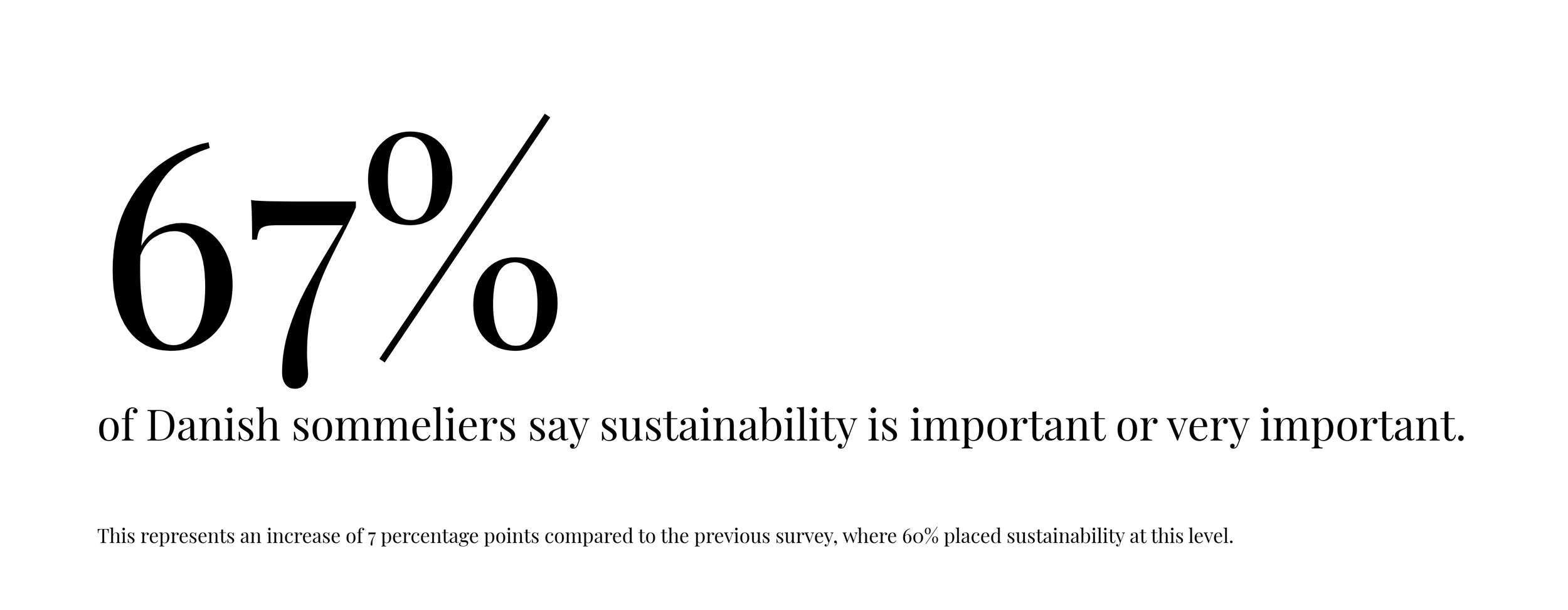
A clear majority of respondents continue to consider sustainability important when selecting wines. In this year’s survey, 67% say sustainability is important or very important (19% very important, 48% important). This represents an increase of 7 percentage points compared to the previous survey, where 60% placed sustainability at this level.
Based on these figures, I get the impression that sustainability has become more widely shared as a core value within the profession. At the same time, the responses suggest that sustainability is increasingly treated as an embedded baseline rather than a separate decision-making factor.
To me, there seems to be less emphasis on single sustainability metrics driving individual choices, and more focus on an overall ethical framework. I read this not as reduced concern, but as a sign that sustainability has matured into an assumed part of professional practice rather than something that needs to be highlighted explicitly for each wine.
"Appellations still provide useful context and orientation, but I read the responses as a sign that they are less central as primary trust mechanisms than they may have been in the past."
Trust and authority: producers over systems
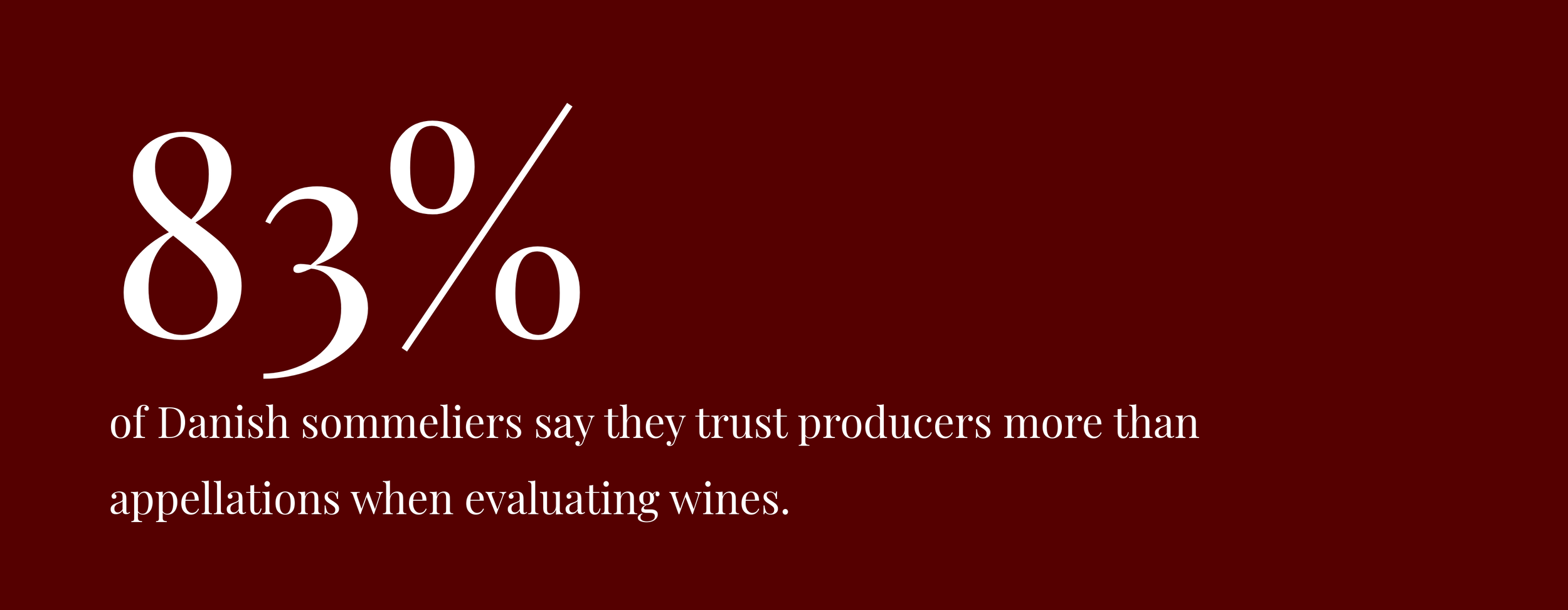
In this year’s survey, 83% of respondents say they trust producers more than appellations when evaluating wines. This stands out as one of the clearest signals in the results.
Based on this figure, I get the impression that authority in wine is increasingly understood in relational terms rather than institutional ones. From my perspective, trust seems to be built through track record, transparency and consistency, rather than through formal classifications alone.
From status to function: the role of wine at the table
Sponsor banner: Skærsøgaard
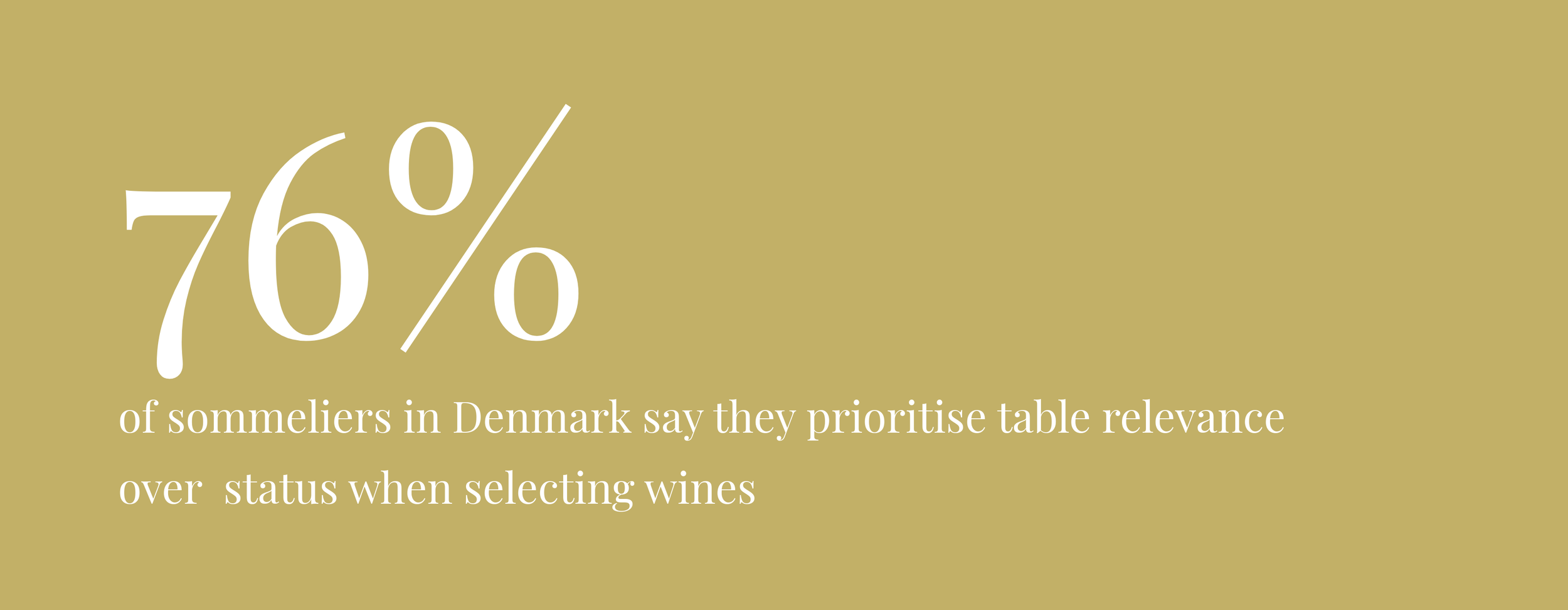
In this year’s survey, 76% of respondents say they prioritise table relevance over status when selecting wines. This suggests a strong focus on how wines function in a service context rather than on their symbolic or prestige value alone.
Based on this, I sense an emphasis on relevance, drinkability and context when curating wine lists. To me, this does not signal a rejection of classic regions or quality wines. Instead, it reflects a more practical and experience-driven approach, where wines are evaluated on how well they perform at the table and how they support food, guests and the overall dining experience.
Ethics ahead of demand: responsibility without guest pressure
In this year’s survey, 83% of respondents say that guests do not ask about fining agents or related production details. At the same time, 67% describe themselves as very or somewhat knowledgeable about fining agents.
Taken together, these figures point to an interesting dynamic between responsibility and demand. Based on the responses, I get the impression that ethical decision-making is driven more by internal professional standards than by direct guest pressure.
No/low alcohol wines: growing relevance and ongoing development
In this year’s survey, 43% of respondents say they currently have no/low alcohol wines on their menu. In addition, 59% describe themselves as very or somewhat knowledgeable about no/low alcohol wines (14% very knowledgeable, 45% somewhat knowledgeable).
Based on these figures, I get the impression that no/low wines are in an active phase of development within the profession. Relevance is clearly acknowledged, and a significant share of sommeliers already work with these wines in practice.
Technology: from expectation to everyday use
In an earlier survey, 50% of respondents said they believed technology would significantly change the sommelier role. In this year’s survey, 40% say they use AI tools such as ChatGPT in their professional work.
Taken together, these figures suggest a shift from expectation to practice. Based on the current responses, I get the impression that technology is beginning to move from abstract discussion into everyday professional use.
To me, this does not read as a disruptive change, but as a pragmatic one.
What sommeliers find interesting right now
When asked what they currently find interesting, the responses point towards a strong focus on people behind the wines. This is reflected in the fact that 52% say winemaker diversity is the most important factor when adding a new wine.
Against this backdrop, what stands out to me in the open responses is not a focus on novelty, but on deeper engagement with familiar regions and grape varieties. Germany, Etna, the Loire and Northern Rhône appear repeatedly, alongside grapes such as Riesling, Pinot Noir and Chardonnay.
I read this as a form of curiosity that is less about discovery and more about interpretation. Familiar frameworks remain important, but they are approached with greater attention to nuance, site and individual producers.
Reflections going into 2026
Looking across the responses in this survey, I get the impression of a profession that is consolidating rather than changing direction. Across several questions, there is a recurring emphasis on shared values, combined with a careful and deliberate approach to how those values are applied in practice.
When I look at answers related to sustainability it appears to function as a baseline rather than a headline, while trust is most often placed in individual producers. At the same time responses around no or low alcohol wines and technical topics such as fining agents suggest areas that are still being explored and discussed.
For me, this indicates a profession that is working within a more complex landscape, where decisions are often made before guests explicitly ask for them and without fully established frameworks. As we would say in Sweden, this moment feels eftertänksam (thoughtful and grounded). Going into 2026, I do not read this as uncertainty, but as a sign of maturity and a willingness to work with nuance, experience, and ongoing reflection